

Hair Transplant in Jaipur Procedure, Techniques, Cost & Recovery
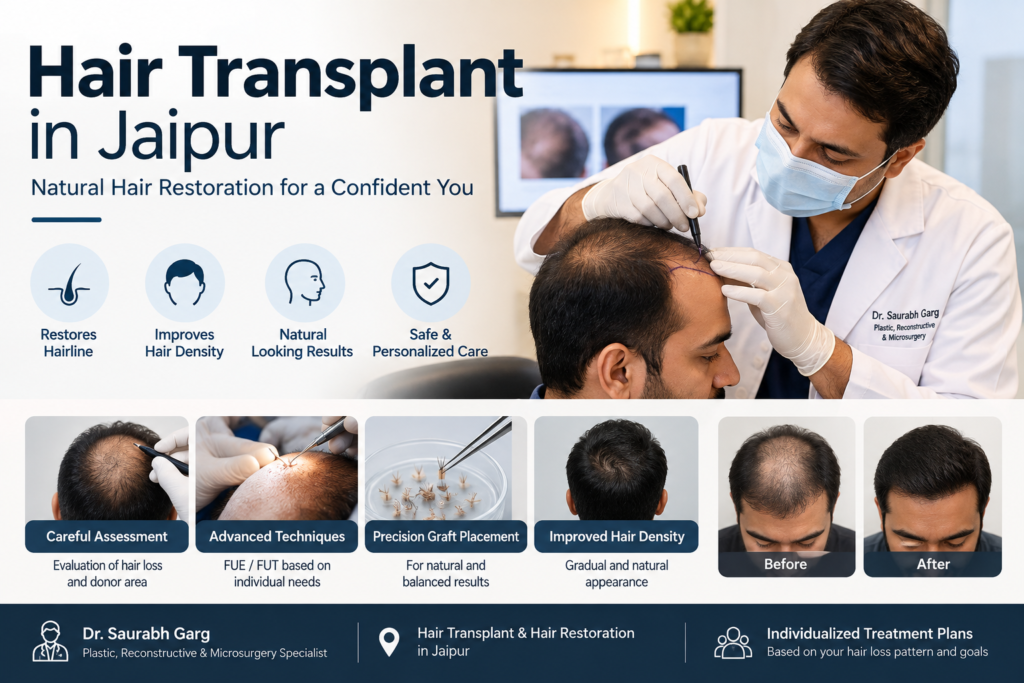
Hair Transplant in Jaipur is an option for people experiencing a receding hairline, thinning hair or pattern hair loss.
Hair loss can look different from one person to another. For some people, the hairline slowly starts moving backwards. Others notice thinning around the crown or a gradual reduction in overall hair density. Many people try oils, medicines or other treatments before they start considering a hair transplant.
The first question is usually simple: “Will a hair transplant actually work for me?”
There is no single answer for everyone. Before planning a transplant, the pattern of hair loss, condition of the scalp, available donor hair and the amount of coverage required need to be considered.
Dr. Saurabh Garg provides hair restoration and scalp treatments in Jaipur as part of his surgical practice. His website lists hair restoration among his aesthetic surgical services.
What Is a Hair Transplant?
A hair transplant is a surgical procedure in which suitable hair follicles are taken from a donor area and placed into areas where additional hair coverage is needed.
The procedure is not simply about moving hair from one part of the scalp to another. The existing hair, donor supply, hairline, direction of growth and areas of thinning all need to be considered when planning the treatment.
According to the American Society of Plastic Surgeons, hair transplantation involves relocating hair-bearing grafts from a donor area to an area affected by baldness or thinning.
The goal is to use the available donor hair thoughtfully so that the transplanted hair can blend with the patient’s existing hair.
Who Is a Good Candidate for Hair Transplant?
A hair transplant is not the right solution for every type of hair loss.
Before considering surgery, it is important to understand why the hair is thinning and whether there is enough suitable hair in the donor area.
People with pattern hair loss may be considered for transplantation when they have an appropriate donor area and realistic expectations about what the procedure can achieve. The availability and characteristics of donor hair are important factors when assessing suitability.
During an assessment, factors such as these may be considered:
- Pattern and extent of hair loss
- Density and quality of donor hair
- Condition of the scalp
- Areas where additional coverage is required
- Existing hair and its density
- Age and progression of hair loss
- Previous hair-loss treatments
- Individual expectations
Age can also be relevant, particularly when hair loss is still progressing. In some younger patients, it may be more appropriate to first understand how the hair loss is developing before planning surgery.
Can women have a hair transplant?
Yes, some women may be suitable candidates for hair restoration surgery. However, hair loss in women can have different causes and patterns, so the underlying reason for the hair loss should be assessed before considering transplantation.
What if the donor area has very little hair?
The donor area is one of the most important factors in hair-transplant planning. If there is limited suitable donor hair, the amount of coverage that can realistically be achieved may also be limited.
This is why an examination of the donor area is important before deciding how many grafts are required.
How Does Hair Transplant Surgery Work?
A hair transplant generally involves two important areas: the donor area, where suitable hair follicles are obtained, and the recipient area, where additional coverage is planned.
The exact process depends on the technique being used and the individual treatment plan.
1. Consultation and planning
The process begins with an assessment of the scalp and hair-loss pattern.
The donor area is examined, the areas of thinning are assessed and the patient’s concerns and expectations are discussed.
Hairline planning is also important. A hairline should be considered in relation to the person’s facial features, existing hair and the possibility of future hair loss.
During a hair-transplant consultation, factors such as hair growth and loss, medical history, previous procedures and expectations may be discussed.
2. Preparing the donor area
Suitable hair follicles are identified in the donor area.
The amount of donor hair available and its characteristics help determine how much coverage can realistically be planned.
3. Extracting the grafts
Depending on the technique used, follicular units may be extracted individually or obtained using a strip method.
The choice depends on the patient’s circumstances, donor area, graft requirements and treatment plan.
4. Preparing the grafts
The extracted grafts are prepared carefully before they are placed into the recipient area.
Proper handling of the grafts is an important part of the procedure.
5. Placing the grafts
The prepared grafts are placed into the areas where additional coverage is required.
Their position, direction and distribution are considered so that the transplanted hair can blend with the existing hair.
6. After the procedure
After the procedure, patients receive instructions for looking after the scalp during the recovery period.
Follow-up may also be recommended to monitor healing and the development of the transplanted hair.
Hair Transplant Techniques
Two commonly discussed techniques are FUE (Follicular Unit Extraction) and FUT (Follicular Unit Transplantation).
Neither technique is automatically suitable for every patient. The choice depends on factors such as the donor area, pattern of hair loss, number of grafts required and the overall treatment plan.
FUE Hair Transplant
In FUE, individual follicular units are removed from the donor area and then placed into the areas where hair restoration is planned.
Because the follicles are collected individually, the procedure does not involve removing a strip of scalp.
The American Society of Plastic Surgeons describes FUE as a technique in which individual follicles are removed from the donor area and inserted into the recipient area.
FUT Hair Transplant
FUT uses a different method of obtaining donor hair.
A strip of skin containing hair follicles is removed from the donor area. Individual follicular units are then prepared from this tissue for transplantation.
Because a strip is removed, FUT results in a linear scar in the donor area.
FUE vs FUT: What’s the Difference?
The main difference is how the donor follicles are obtained.
| FUE | FUT |
|---|---|
| Individual follicular units are extracted | A strip of donor tissue is removed |
| No linear strip of donor tissue is removed | Leaves a linear donor scar |
| Individual extraction sites | Follicles are separated from the donor strip |
| Suitable approach depends on the patient | Suitable approach depends on the patient |
The appropriate technique should be decided after assessing the patient’s hair loss, donor area, graft requirements, previous procedures and long-term hair restoration goals.
How Many Grafts Do You Need for a Hair Transplant?
One of the first questions many patients ask is:
“How many grafts will I need?”
There is no fixed number that works for everyone.
Someone who mainly wants to improve a receding hairline may have very different requirements from someone with thinning across the front, mid-scalp and crown.
What is a hair graft?
A graft is a small unit of tissue containing one or more hair follicles.
During a transplant, suitable grafts are taken from the donor area and placed into the areas where additional coverage is required.
The number of hairs is not necessarily the same as the number of grafts because a graft can contain more than one follicular unit.
Does a higher graft number mean a better result?
Not necessarily.
The donor supply is limited, so it needs to be planned carefully. The hairline, existing hair, areas of thinning and possible future hair loss also need to be considered.
The aim is not simply to use the maximum possible number of grafts. It is to use the available donor hair appropriately for the patient’s treatment plan.
How is the graft requirement decided?
The assessment may consider:
- Pattern of hair loss
- Donor hair density
- Donor hair quality
- Area requiring coverage
- Existing hair
- Planned hairline
- Patient’s expectations
A proper assessment is therefore more useful than choosing a transplant based only on a fixed graft number found online.
What to Expect Before, During and After Hair Transplant Surgery
If you have never had a hair transplant before, it is natural to have questions about what happens before and after the procedure.
Before the procedure
The first step is a consultation.
Your hair-loss pattern and scalp are assessed, with particular attention to the donor area. The areas where you want more coverage are also examined.
This is the time to discuss your hairline, areas of thinning, expectations and concerns.
You should also tell your doctor about medicines, supplements, allergies or existing medical conditions before surgery.
The American Society of Plastic Surgeons recommends following the surgeon’s specific preparation instructions regarding medicines, smoking, eating and drinking before surgery.
During the procedure
The scalp and donor area are prepared before the procedure begins.
Depending on the technique being used, suitable hair follicles are obtained from the donor area and prepared for transplantation.
The recipient area is then prepared according to the planned hairline and distribution of the grafts.
The grafts are placed carefully so that their position and direction are appropriate for the surrounding hair.
The exact duration and steps can vary depending on the individual treatment plan and number of grafts.
After the procedure
After the procedure, you will receive instructions about caring for your scalp during the early healing period.
Some temporary changes, such as redness, swelling, tenderness or small scabs, may occur.
The transplanted hair does not appear fully grown immediately. Hair growth takes time, so the appearance soon after surgery should not be considered the final result.
Hair Transplant Recovery and Aftercare
Recovery is an important part of the hair-transplant process.
The scalp needs time to heal and the transplanted follicles need time to settle into their new location.
Your surgeon will provide specific instructions based on your procedure. Those instructions should take priority over general advice found online.
The American Society of Plastic Surgeons notes that recovery depends on the extent and complexity of the procedure and that patients may be advised to avoid vigorous activity during the early recovery period.
Washing your hair
Your doctor will tell you when and how to wash your hair after the procedure.
During the early recovery period, the transplanted area generally needs to be handled gently.
Avoid rubbing, scratching or picking at the treated area unless specifically instructed otherwise.
Sleeping after the procedure
You may be advised to take extra care while sleeping during the initial recovery period, particularly if there is swelling or tenderness.
Follow the sleeping-position and pillow instructions provided by your surgical team.
Exercise and physical activity
Heavy exercise and activities that cause significant sweating may need to be restricted during the early recovery period.
The exact timing depends on the procedure and your individual recovery.
Ask your surgeon when you can safely return to your normal workout routine.
Shedding after a hair transplant
Some transplanted hairs may shed during the early stages following the procedure.
This can be worrying when you first notice it, but temporary shedding can occur as part of the hair-growth cycle following transplantation. The ASPS also notes that temporary shedding after transplantation can occur during recovery.
When Does Hair Start Growing After a Hair Transplant?
A common question after hair transplantation is:
“When will I actually see my new hair?”
The answer is not immediate.
The transplanted follicles need to settle into their new location and go through their natural growth cycle.
Some of the transplanted hair may shed during the early period. This does not necessarily mean that the transplant has failed.
New growth develops gradually, and the rate can vary from one person to another.
Why does transplanted hair take time to grow?
The follicle needs to recover and continue through its natural growth cycle after transplantation.
The visible hair immediately after the procedure therefore does not represent the final result.
Factors such as individual hair characteristics, extent of hair loss, donor area and healing can affect how the result develops.
When can the result be judged?
Hair growth develops gradually over time.
Your surgeon can assess your progress during follow-up appointments and explain whether the growth is developing as expected.
It is also important not to compare your progress too closely with another patient’s timeline. Two people can undergo hair transplantation and experience different patterns of growth.
Possible Risks and Side Effects
Like any surgical procedure, a hair transplant has potential risks and side effects.
Some temporary effects may include:
- Redness
- Tenderness
- Mild swelling
- Small scabs
- Itching
- Temporary numbness or altered sensation
- Temporary shedding
Less common complications can include infection, excessive bleeding, noticeable scarring, poor graft growth or an uneven appearance.
The American Society of Plastic Surgeons also notes that infection, bleeding, scarring and failure of some grafts to take are possible risks, and that continuing hair loss can affect the overall appearance after transplantation.
Can a hair transplant leave scars?
Scarring depends partly on the technique used.
FUE involves individual extraction of follicular units and generally produces small extraction marks.
FUT involves removing a strip of donor tissue and therefore produces a linear scar.
How noticeable any scar becomes can vary from person to person.
Can a hair transplant fail?
A hair transplant does not guarantee a particular density or appearance.
Graft survival and visible growth can vary, and existing non-transplanted hair may continue to thin in the future.
This is why appropriate assessment and realistic treatment planning are important before surgery.
If you experience symptoms that concern you during recovery, contact your surgical team rather than trying to diagnose the problem yourself.
Hair Transplant Cost in Jaipur
“Hair transplant kitne ka padega?” is one of the first questions many patients ask.
The cost of a hair transplant in Jaipur is not the same for every patient.
It can depend on the extent of hair loss, number of grafts required, donor area, technique and complexity of the treatment.
Someone who mainly needs treatment around the hairline may have very different requirements from someone who has significant thinning across several areas of the scalp.
What affects hair transplant cost?
Factors that may influence the overall cost include:
- Number of grafts required
- Extent and pattern of hair loss
- Availability and quality of donor hair
- Technique used
- Complexity of treatment
- Number of sessions required
- Surgical and follow-up care
This is why a fixed price quoted without assessing the scalp may not accurately represent the cost for an individual patient.
Does a higher number of grafts mean a better result?
Not necessarily.
The goal is to use the available donor hair carefully and place grafts where they can provide useful coverage.
The required number of grafts should therefore be decided after assessing the scalp and discussing the patient’s goals.
How can you find out the cost for your case?
A consultation allows the hair loss and donor area to be assessed.
After understanding the treatment requirements, the proposed approach and associated costs can be discussed with the patient.
When comparing hair transplant cost in Jaipur, it is also useful to understand what is included in the treatment, who is performing the procedure and what follow-up care is provided.
Hair Transplant Before and After
Before-and-after photographs can be useful when researching hair transplantation, but they should not be treated as a promise of what your own result will look like.
Every patient has a different starting point, donor area and hair characteristics.
Dr. Saurabh Garg’s current website includes a before-and-after section featuring a hair-transplant result.
When looking at a result, consider more than simply the amount of hair visible in the photograph.
The hairline, direction of growth, density and how the transplanted hair blends with existing hair can all be important.
Why are results different for every patient?
The starting level of hair loss, donor hair quality, number of grafts, treatment area and individual hair-growth characteristics can all affect the result.
Some patients may mainly want to improve a receding hairline, while others may need coverage over a larger area.
For this reason, your treatment plan should be based on your own scalp and donor hair rather than on another person’s photographs.
Why Consider Dr. Saurabh Garg for Hair Restoration?
Choosing a surgeon for hair restoration is an important decision.
Hair transplant surgery involves more than the procedure itself. Assessment of the donor area, hairline planning and the overall treatment approach all matter when deciding whether surgery is appropriate.
Dr. Saurabh Garg is a Plastic, Reconstructive & Microsurgery Specialist in Jaipur. His current website lists Hair Restoration & Scalp Treatments among his aesthetic services.
You can learn more about Dr. Saurabh Garg and his surgical practice on the About Dr. Saurabh Garg page.
His broader practice includes aesthetic surgery and reconstructive microsurgery. The treatment approach described on his website includes consultation, treatment planning, procedure and recovery support.
If you are considering a hair transplant in Jaipur, a consultation can help you understand whether hair restoration surgery is appropriate for your situation and what options may be suitable.
Hair Restoration Services
Hair restoration is not limited to one particular type of hair loss.
The appropriate treatment depends on the cause and pattern of hair loss, scalp condition and the amount of suitable donor hair available.
Dr. Saurabh Garg’s Hair Restoration & Scalp Treatments are listed under the aesthetic surgery services on his website.
Depending on the patient’s requirements, consultation may involve:
- Assessment of hair loss and scalp condition
- Evaluation of the donor area
- Hairline and coverage planning
- Discussion of hair transplant surgery where appropriate
- Post-procedure care
- Follow-up and monitoring
The treatment plan should be based on an individual assessment rather than choosing a procedure simply because it is commonly advertised online.
Hair Transplant Consultation in Jaipur
A consultation is an important first step if you are considering a hair transplant.
It gives you an opportunity to discuss your hair loss and understand whether a transplant is suitable for your particular situation.
During consultation, the doctor can assess the pattern of hair loss, examine the donor area and discuss the areas where you are looking for more coverage.
Your expectations, medical history and previous treatments may also be relevant when planning treatment.
Dr. Saurabh Garg provides consultations in Jaipur. His website currently lists HCG Cancer Centre, Mansarovar and Health Route Clinic, Jagatpura among his clinical locations.
Before proceeding with surgery, patients should understand the proposed procedure, expected recovery, possible risks, limitations and follow-up care.
If you are researching a hair transplant doctor in Jaipur, consultation gives you an opportunity to ask questions and understand which options may be appropriate for your situation.
Frequently Asked Questions About Hair Transplant
Is a hair transplant permanent?
Transplanted hair can provide long-term restoration, but results vary between patients.
The transplanted follicles and existing non-transplanted hair can behave differently, so future hair loss may still affect the overall appearance.
Is a hair transplant painful?
The level of discomfort varies from person to person.
Appropriate anaesthesia is used during the procedure, while some tenderness or discomfort may occur during recovery. The type of anaesthesia and recovery experience can vary according to the procedure.
Your surgeon can explain what to expect and how discomfort will be managed.
How many grafts will I need?
There is no standard number for every patient.
The requirement depends on the pattern of hair loss, area requiring coverage, donor hair and treatment goals.
A scalp and donor-area assessment is needed to estimate the graft requirement.
How long does hair transplant recovery take?
Recovery varies between patients and depends partly on the procedure performed.
Redness, swelling, tenderness and small scabs can occur during the early healing period. Recovery instructions should come directly from your surgical team.
When will new hair start growing?
Hair growth takes time.
Some transplanted hair may shed during the early stages before new growth develops. The visible result therefore changes gradually rather than appearing immediately after surgery.
Can a hair transplant treat a receding hairline?
A hair transplant may be considered for some people with a receding hairline.
Whether it is appropriate depends on the pattern of hair loss, donor hair and the hairline that can realistically be planned.
Can women have a hair transplant?
Some women may be suitable candidates for hair restoration surgery.
However, female hair loss can have different causes, so the reason for the hair loss should be assessed before considering transplantation.
What is the difference between FUE and FUT?
The main difference is how donor follicles are obtained.
FUE involves individual follicular extraction, while FUT involves removing a strip of donor tissue and separating the follicles from it.
The appropriate technique depends on the individual patient’s hair loss, donor area and treatment requirements.
How much does a hair transplant cost in Jaipur?
There is no single price that applies to every patient.
The cost can depend on the number of grafts required, technique, extent of hair loss, donor area and treatment complexity.
A consultation is the best way to understand the likely requirements and associated cost for an individual case.
Can my existing hair continue to fall after a transplant?
Yes.
A transplant moves selected hair follicles to another area, but it does not necessarily stop the underlying process causing hair loss in other, non-transplanted hair.
This is one reason why long-term hair-loss planning is important. Continued or progressive hair loss can affect the overall appearance after transplantation.
Considering a Hair Transplant in Jaipur?
If you are noticing a receding hairline, thinning hair or loss of density, the first step is to understand what is causing the hair loss and whether a transplant is appropriate for you.
Dr. Saurabh Garg provides hair restoration and scalp treatments in Jaipur.
During a consultation, your hair-loss pattern and donor area can be assessed and the available treatment options discussed.
Book a consultation to discuss your hair restoration goals and understand what may be suitable for your situation.